


How many times have you seen this one?
Happy holidays. As this is going out, I'm very likely visiting family right now and am lacking the time to post something in time for the season. This preface was written in April, actually. I've posted this before via Letterboxd as a review for the NBC Live take on what will be discussed, but I felt it would be neat to have it on here as a little dusty treat to see in time and will spare me the work of getting something out before the day. This was written as a community college assignment for my theater arts course, which was one of two writeups about a Broadway production you had seen during the semester. I didn't get an opportunity to see anything other than this, so I'd say it's fitting enough. You could say it's a precursor to the typical ai blog post, with the descriptions and fanciful anecdotes, but it's very much its own thing that I think I got a B+ on. It's been cleaned up a little and reformatted for the site. Enjoy.
Dr. Seuss’ How the Grinch Stole Christmas and the Problem with Demographical Commodification
 |
What if I told you that Max fucking dies at the end? |
Considering I've not seen many plays (Broadway or regardless) to be arriving in the Detroit area prior to this due date, I'd considered seeing The Grinch as part of a bigger whole. Yes, I'm quite excited for the Christmas season, but I was also feeling rather Charlie Brown about the whole matter of seeing a Christmas show over a month before the actual holiday itself. I would blame capitalism and the money machine as a whole for this factor, but to reach to the actual direct cause in this paragraph alone would lead me to ending this essay/critique early. However, I would rather make example of this sort of philosophy in the production itself, whereas most of the original material directly contradicts this sort of line of thinking.
Before I continue further about the production itself, I must make note of the organizers. 313 Presents, the entertainment licensing company owned by Ilitch Holdings, does not offer student rush for their events. They offer student rush for their sporting events, such as tickets to Red Wings and Pistons games, but not towards any theatrical or venue-related activities. I had called them at their number asking for this opportunity, to which I was sent the link to the Red Wings rush tickets. I called again asking for the 313 Presents rush tickets, if any, and was told I would be transferred to another line. I was transferred, but I didn't receive a proper response. Regardless, knowing about this specific type of treatment towards those getting an education, mainly college and university students, creates a blur of confusion. Would they see sports for cheaper, even if uninterested instead of what they really want to see at gouging rates?
Nevertheless, I entered the venue at the 4:00 PM Saturday show, looking forward to a nice Christmas production. I see merchandise in the lobby for Grinch-related items, and LED necklaces in the shape of a heart, lighting up as if it were growing three sizes. It's mildly deceptive in this way, that the moral of the story overall is that the Grinch understands that for all his life, he believed Christmas to be completely commercial and rather irritating due to everyone seemingly enjoying it for the commercial and capitalistic aspect, when it is completely the opposite in reality. In the truest reality, that being out of fiction, it almost feels like self-parody, but completely without a shred of irony.
Everywhere I stand in this lobby is swamped with parents, their children, and rotund women over the age of 45 in Grinch shirts and sweaters. It feels like though we are here to see the Grinch, we aren't quite listening to his plight. Instead, a large section of the audience entertains exactly what he believes to be true.
And this is most of the problem: Seuss quite understood what he meant by the moral of the story. Much of everything that came after his passing in the early 90s, (save, for whatever reason, Ron Howard’s adaptation starring Jim Carrey, which despite being mixed among Seuss purists, is irreverently satirical towards capitalism, seasonal depression, politics, and religion) doesn't understand the anti-materialism that the original story represents. This is my theory: those who adapted this specific work only truly intended it to exist as a Christmas show, to get families with children excited for the holidays in seats, to sell merchandise, and to not try for any Tonys whatsoever; to exist as purely children's entertainment.
 |
| Seuss on children's literature in Top Cel, an animation union newsletter (Local 841!). |
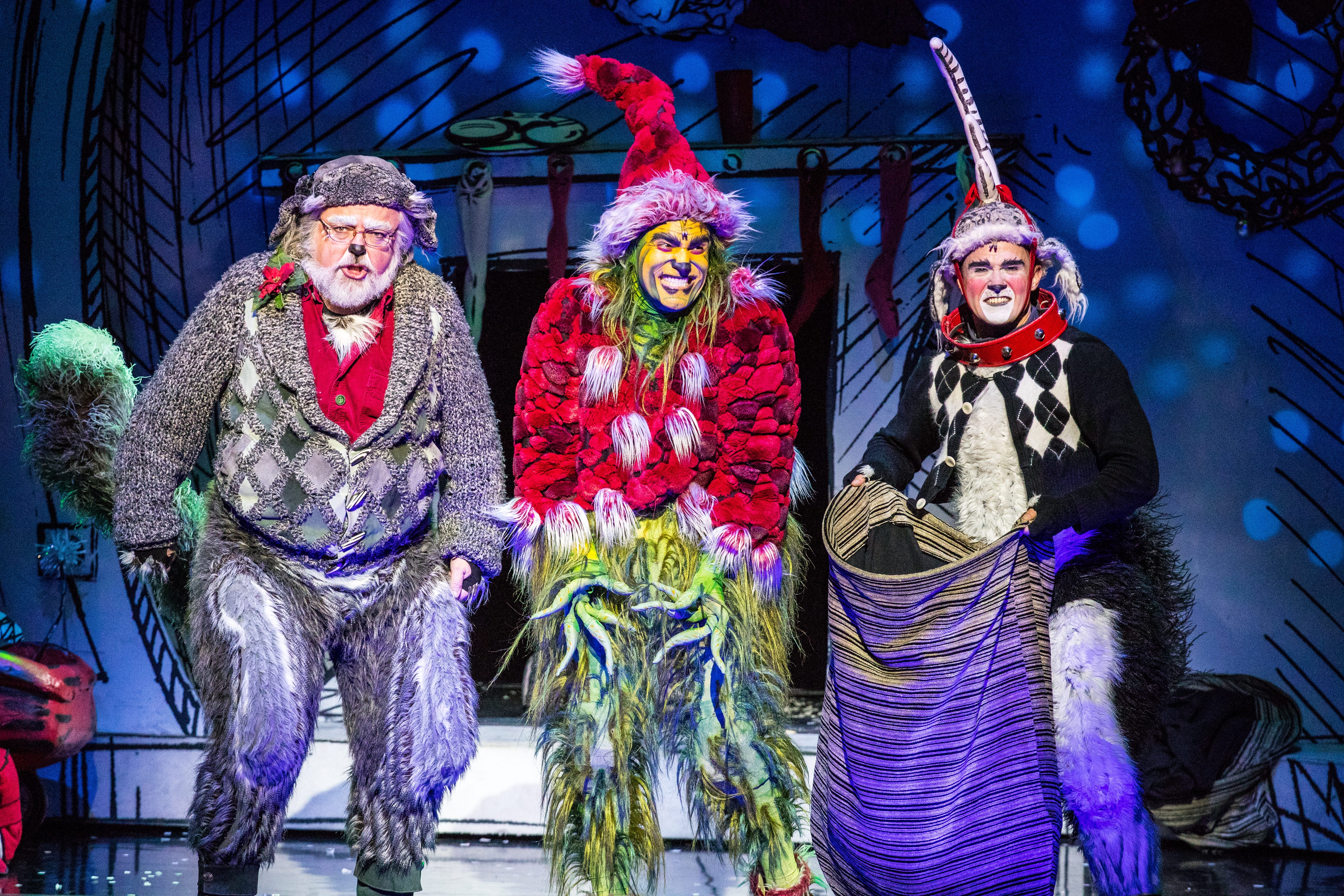
I'm not saying the show is bad at all! It's incredibly well-made and well-cast, it utilizes puppetry, wire-hanging, surrealist and deliberately unrealistic prop design, elaborate projection effects, and very good costume design and makeup. It looks very, very good for a Christmas show. But I can't say much of the same for the writing and songs, which are mostly forgettable aside from the obligatory “You’re a Mean One (Mr. Grinch)” (lyrics by Seuss himself by the way) which is sung twice during the show, once as the Grinch steals the Christmas novelties from Cindy Lou’s home, and again as he loads them into his sleigh (accompanied by, for whatever reason, live sheet-flipping sing-along lyrics for the song, for that true “Hello Milwaukee!” audience participation experience).
I will mention a detail that I saw two ways about: the Grinch himself was never a “gross-out” character. That interpretation only truly exists through Jim Carrey’s portrayal. In the first rendition of the song in the show, the Grinch takes cookies and milk off the fireplace, chugs the milk in its entirely, and lets out a massive burp shortly followed by a massive fart. My honest interpretation, rather than it totally just trying to get the kids' attention and make them holler because fart funny (the objectively correct answer in an Occam's Razor fashion), almost seems to defile the work of Seuss himself. It's unintentionally defiling, in a bizarre way, that of which I wouldn't have even considered if I were a child in the audience rather than a college student pushing 20.
Most of the misinterpretations of the source stem from most of the modern adaptations attempting to flesh out the Whos as characters in the show, which I feel limits most of the alienation of the book. The Grinch is a character who we read from his perspective, and to switch to the Whos to see them attempt to rationalize the Grinch’s behavior (as if ambiguity with a villain protagonist is too much for today’s child). The Grinch doesn't understand that Christmas is not nearly about the gifts and presents and etc so have you. It's about spending time with family and the love of the world in a cold unforgiving winter. The heat of our hearts is what keeps us truly warm during the cold season, and in the beginning it's the hottest. The Grinch is unloved and disrespectful in return. He doesn't know that yes, while Christmas is capitalistic and fully embracing of commercialism, it's not and never was intended to be that way.
 |
| Looked pretty good in some respects! |
Regarding the first point, there's a song in the show where Cindy Lou’s parents and family go shopping for the kids and other members, to which the moral is that “the gifts you receive don't have to be exactly what you want, but it's more of the thought that counts”. It's directly contradictory to the message of the book and it's frustrating to even include it! We're not supposed to agree with the Grinch, and yet the play is directly setting us up to embrace the commercialism of Christmas and not stopping to think of whether or not it's being faithful at all.
While much of the play is children’s trite, I would say that it's got some pretty interesting value in an ironic or culty sense, that one would go to the play expecting something interesting out of an adaptation of The Grinch, the sort of bizarre twists and turns that arose from the previous two adaptations. However, though it's relatively accurate to the book regardless of my groupings of the inaccuracy, it manages to at least feel like a Grinch thing and not some sort of hideous three-headed Seussian amalgamation. Of a score of five, maybe a three would suffice? But I think I'm giving it too much credit regardless.
No comments:
Post a Comment
Anything worth mentioning?